Where Are the Best New Home Incentives in the Sacramento Area? A Builder-by-Builder Look for Fall 2026
If you’re thinking about buying in the Sacramento area right now, one question should be near the top of your list: where are the best new home incentives? Mortgage rates are sitting in the 7% range, up from roughly 6.4% this time last year, and for a lot of buyers, builder incentives are the difference between a move that works on paper and one that doesn’t.
On our latest live show, I sat down with Ben, a new home sales consultant with Meritage Homes who has also worked for KB Home, Woodside Homes, and Richmond American. We talked through the pros and cons of buying new versus resale, which builders are offering what, and which parts of the region are most likely to have deals heading into winter. One note up front: Ben works for a builder, so his perspective on Meritage comes from the inside. I’ve tried to balance that with what our team is seeing across the market.
This isn’t a “you should buy now” post. Some people have a life change and need to move regardless of rates. If that’s you, this is about making that move as smart as possible.
Why New Construction Is Getting So Much Attention Right Now
The biggest reason is simple: rate help. In a resale purchase, it’s hard to get a meaningful rate buydown from a private seller. Builders, on the other hand, have been offering things like:
- Seller credits toward a rate buydown or closing costs, in some cases in the tens of thousands of dollars
- 3-2-1 buydowns, where the rate starts lower in year one (we’ve seen first-year rates as low as 1.99%) and steps up each year until it reaches the note rate
- Forward commitments, where a builder locks a block of below-market fixed-rate financing for its buyers
- Adjustable-rate options at a lower starting rate
On top of financing, new homes come with builder warranties, modern insulation and energy efficiency, often solar, and very little deferred maintenance. A lot of the resale homes on the market right now need work: aging HVAC systems, older roofs, and other repairs that land on the new owner from day one. As Ben put it, an older home doesn’t eliminate maintenance costs, it just moves them onto your budget. Setting aside a few hundred dollars a month for the inevitable furnace, roof, or water heater is a real cost even if it never shows up on a monthly statement.
New communities also tend to come with new schools, parks, fire stations, and shopping nearby, and Sacramento buyers have consistently shown they value that.
The Honest Downsides of Buying New
New construction isn’t right for everyone, and there are a few things you should know going in.
It’s a long-term play. If you buy in a community that’s still actively building, and you need to sell in two or three years, your biggest competition may not be the house down the street. It may be the builder down the block, offering a brand-new home with a fresh rate buydown. Your home may have better landscaping and finishes by then, but a buyer comparing your listing to a builder offering a subsidized rate is going to notice the difference. In active-growth areas like Elk Grove, Rancho Cordova, and parts of Folsom, plan to hold longer than you might in an established neighborhood.
Established neighborhoods have character new ones don’t. In a brand-new development, the tallest tree is usually not much taller than you are. In an older neighborhood, the trees are grown in, the streets are settled, and you know exactly what you’re moving into. Many new communities also come with HOAs and Mello-Roos special tax assessments, which add to your monthly cost and should be part of your math.
Sometimes the right house is a resale house. Ben said it well near the end of the show: not every decision comes down to the interest rate. If you find a resale home you truly love, in the location you want, that can outweigh a better rate somewhere else.
My advice: look at both. If your agent is only showing you resale, you’re missing a large share of the Sacramento market, because builders are active almost everywhere in the region.
A Closer Look at Meritage Homes
Meritage Homes works a little differently from most builders in our area. Rather than building to order from the dirt up, Meritage primarily sells completed or nearly completed quick move-in homes. That makes them a closer one-to-one comparison with a resale home: in many cases they can close in about 30 days, and homes can come with appliances, washer and dryer, refrigerator, blinds, and even a finished backyard. The tradeoff is that you’re choosing from what’s built, not designing your own.
A few things stood out to me when I toured their newer Lincoln community:
- Homes around 3,000 square feet with three-car garages, which several nearby competitors in that community don’t offer
- Backyards deep enough for a pool, which matters a lot in a place like Lincoln where many buyers want their home to feel like a weekend retreat
- Pricing that, based on what Ben described, can land around the $650,000 range for a four-bedroom, roughly 3,000-square-foot home in Lincoln, compared with what we’d estimate as roughly $100,000 more for similar square footage in West Roseville
On incentives, Ben said Meritage has been offering seller credits of up to 6% of the purchase price when using their affiliated lender. On a $700,000 home, that’s about $42,000. Buyers can generally direct that credit toward whatever structure fits them best: a fixed-rate buydown, a 3-2-1, an ARM, or closing costs. He also mentioned a 5.5% 30-year fixed forward commitment, while noting that the cost of these programs changes daily and the rate was already being reconsidered. In other words, treat any specific number here as a snapshot, not a promise.
By Ben’s account, Meritage’s Natomas and Galt communities have been selling quickly, while Vineyard and Delta Shores have been slower. The Vineyard product in particular is larger homes on larger lots (some around 10,000 square feet), which appeals to a narrower group of buyers.
Builder by Builder: What We’re Seeing on Incentives
Every builder runs its business differently, and incentives vary by community, floor plan, and even the week. Here’s a general read based on what our team and Ben have observed recently.
Taylor Morrison: I call them the steady horse of our market. Consistent product, strong finishes, and rarely any client complaints. Incentives tend to be modest; we’ve typically seen something in the range of 2% or a $10,000 to $15,000 credit. They tend to hold their pricing.
Richmond American Homes: Solid product, personalizable options, and some of the more consistent incentives we’ve seen, including FHA programs and 3-2-1 buydowns. Rancho Cordova has been one of their better spots for deals. Their West Roseville communities are nearly sold out, so expect less room to negotiate there. Richmond American and Woodside are now both under the Sekisui House umbrella, so it’s worth watching how pricing and incentives evolve as those brands sort themselves out.
JMC Homes: A respected local builder with some of the best standard features in the region, so you rarely walk into a stripped-down JMC home. They build mostly in Placer County, including West Roseville and Placer One. Price flexibility has generally been modest, around 2%, though they’re carrying standing inventory in some areas.
Shawood (Sekisui House): A premium, design-forward builder with an emphasis on long-term build quality and fire-resistant exterior materials, which can matter for home insurance. Their Folsom homes have historically started near $2 million, though we’ve seen at least one plan come in under that recently. Their upcoming Loomis community is expected to start considerably higher. Don’t expect much negotiation here.
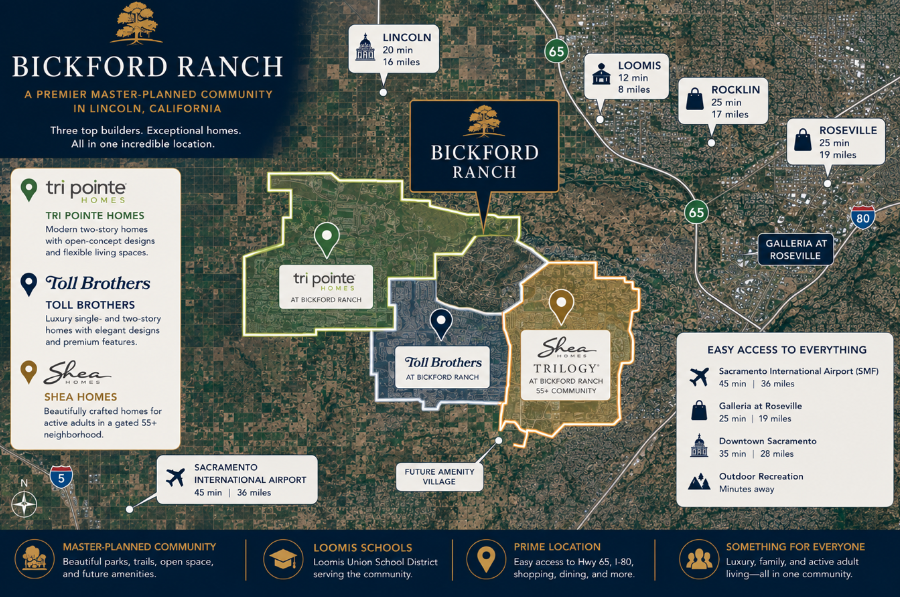
Toll Brothers: Highly personalizable luxury homes, but incentives depend heavily on the specific community. When I checked in recently, Rocklin and Bickford Ranch were selling steadily with little to offer, while their Folsom community had more flexibility. Don’t assume a deal at one Toll community applies to another.
KB Home: KB tends to compete on price rather than incentives. In Elk Grove, demand has been strong enough that there’s been a waiting list. KB and Lennar often give you good “bones” (the square footage and floor plan) with room to upgrade over time.
Lennar: Lennar has a history of adjusting prices quickly when they need to move inventory, especially in areas like North Lake. That can be great timing if you’re buying, but buyers should go in knowing that a neighbor could buy a similar home for less a few months later.
Beazer Homes: We’ve seen Beazer be aggressive in Rancho Cordova, including some price flexibility and FHA rate programs.
Brookfield Residential: In West Roseville, Brookfield has shown flexibility on both price and buydown or closing cost credits, depending on the plan.
A general rule across builders: most won’t make large price cuts, because it affects appraisals for everyone else in the community. Credits toward rate and closing costs are far more common than big price reductions, and there are also legal limits on how much a seller can contribute toward a buyer’s financing. When a builder hits that limit, the conversation often shifts to things like solar or backyard landscaping instead.
Where Location Affects Incentives
Folsom and Elk Grove: Consistently in-demand markets. Outside of a specific Toll Brothers community in Folsom, we’re not seeing many standout deals in either city.
Rocklin: Fewer active builders and limited standing inventory, so incentives are likely to be modest.
West Sacramento: Only a small number of active communities, which means less competition among builders and fewer big incentives.
Placer One, Vineyard, South Sacramento, and Lincoln: These are the areas where I expect buyers to find the strongest incentives this winter. Placer One is a newer area that hasn’t built up momentum yet, and several builders are selling there at once, which naturally creates competition for buyers. Vineyard sits between Elk Grove and Rancho Cordova and is within Elk Grove Unified School District, yet comparable floor plans there have often priced well below similar homes in Elk Grove proper.
The tradeoff with these areas is real. They can mean longer drives, less established retail and services, and, depending on the area, higher utility costs or special tax assessments. Run the full monthly numbers, not just the rate. But history in this region is worth remembering: Roseville, Folsom, and Rancho Cordova were all once considered “too far out,” and buyers who got in early in those areas have generally done well. There’s no guarantee any specific area will follow that path.
A Few Important Caveats
Incentives are time-sensitive. Everything in this post reflects what we were seeing in early October 2026. Builder programs can change weekly, sometimes daily. Always confirm current terms directly with the builder and your lender before making decisions.
Investors and second-home buyers usually get different terms. Many of the most attractive builder financing programs are limited to primary residences. In our experience, investors often see something closer to 2% in incentives, so read the fine print on any advertised rate.
Builder-affiliated lender programs come with conditions. Many incentives require using the builder’s preferred lender. Compare the full loan terms, not just the headline rate, and consider getting a second quote.
Nobody knows where rates are headed. You’ll hear “marry the house, date the rate” a lot. I’m not telling you that, because I genuinely don’t know when rates will come down. Buy a home whose payment works for you today, and treat any future refinance as a bonus, not a plan.
This is typically a slower season. Sacramento’s market tends to cool from late summer through January, and this year we also have rate uncertainty and a midterm election in the mix. For cash buyers and well-prepared financed buyers, that can mean more negotiating room on both new and resale homes.
The Bottom Line
If you need to buy in the Sacramento area right now and want help with your rate, new construction is where most of that help currently lives. But the best incentive in the world doesn’t make up for the wrong house, the wrong location, or a plan to sell in two years in a community that’s still building. Look at both new and resale, understand the full monthly cost, and choose the home that fits your life.
Thinking about relocating to the Sacramento area or touring new home communities? Our team works with buyers moving here from out of state and tours builder communities across the region every week. Reach out anytime and we’ll help you sort through the incentives, the floor plans, and the tradeoffs for your situation.
Mark McDonough
Sacramento Real Estate Group
Mark McDonough, California DRE #02016066, is a licensed real estate salesperson with Guide Real Estate, DRE #01976964.
This article reflects market commentary and general observations as of October 2026 and is provided for informational purposes only. Builder incentives, pricing, interest rates, and availability are set by the builders and lenders, change frequently, are subject to qualification, and are not guaranteed. Guest commentary from a builder representative reflects that individual’s views and their employer’s programs, not those of Guide Real Estate. Square footage, pricing estimates, and community comparisons are approximate. This is not financial, legal, tax, or lending advice. Consult a licensed lender and other appropriate professionals about your specific situation. Information deemed reliable but not guaranteed. Equal Housing Opportunity.