Sacramento Real Estate Market Update — August 2026
If you've been watching the Sacramento market this summer and wondering whether it's finally cooling off, the honest answer is: a little, but not in the way the headlines make it sound. August numbers are in, and when you put them side by side with July — and with August of last year — a clear picture emerges. This is a market that's slowing down for entirely normal, seasonal reasons, not one that's falling apart. Here's what the data says, what it actually means if you're buying or selling in the Sacramento area, and why the "official" read on this market might be more favorable to buyers than it looks at first glance.
The Market at a Glance
August closed out with 8,706 homes for sale across the region, 2,855 homes sold, and 3,126 homes going pending. Months of supply ticked up to 3.0 — still a fairly tight market historically, but noticeably looser than it was in the spring.
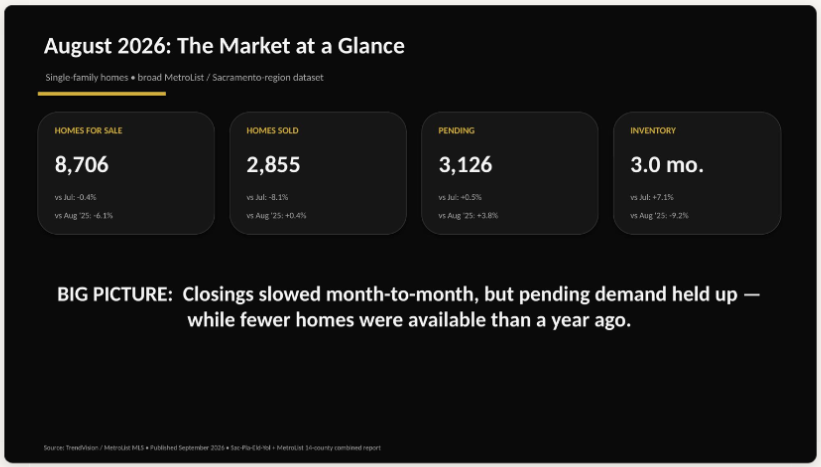
The short version: closings slowed down from July, but pending activity held steady, and there were still fewer homes available than there were a year ago. That combination — softer closings, steady demand, tighter inventory than last year — is exactly what a normal late-summer slowdown looks like in Sacramento.
What Changed From July
Every August, Sacramento's market takes its foot off the gas a bit as the spring and early-summer buying rush fades. This year was no exception. New listings dropped 12.5% from July as sellers who were going to list this year had mostly already done so. Closed sales fell 8.1% along with them. Median sold price slipped 1.3% to $550,000. Average sold price came down 2.7% to $623,000. Price per square foot eased 1.5% to $321.
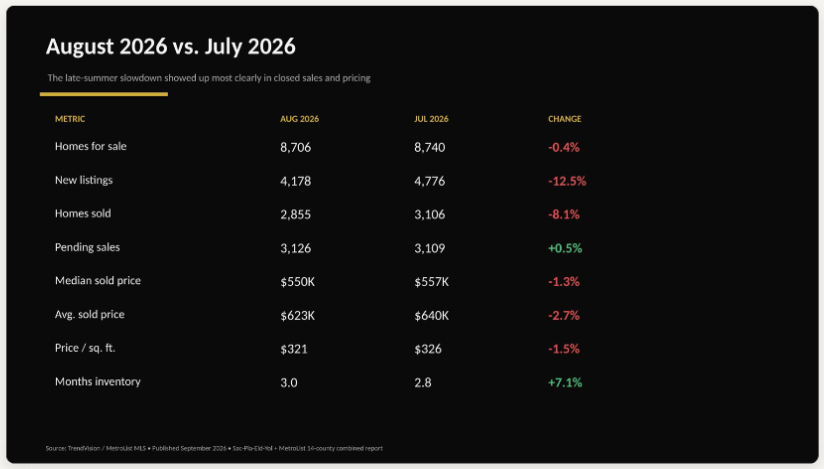
Pending sales, interestingly, held essentially flat (+0.5%), which tells you buyers who were already in the process kept moving forward even as fewer brand-new deals got started. Months of inventory rose 7.1% to 3.0, giving buyers a bit more breathing room than they had a month earlier.
How This August Compares to Last August
Zoom out to a year-over-year view and the story gets more interesting — and more reassuring if you're a seller who's nervous about where things are headed.
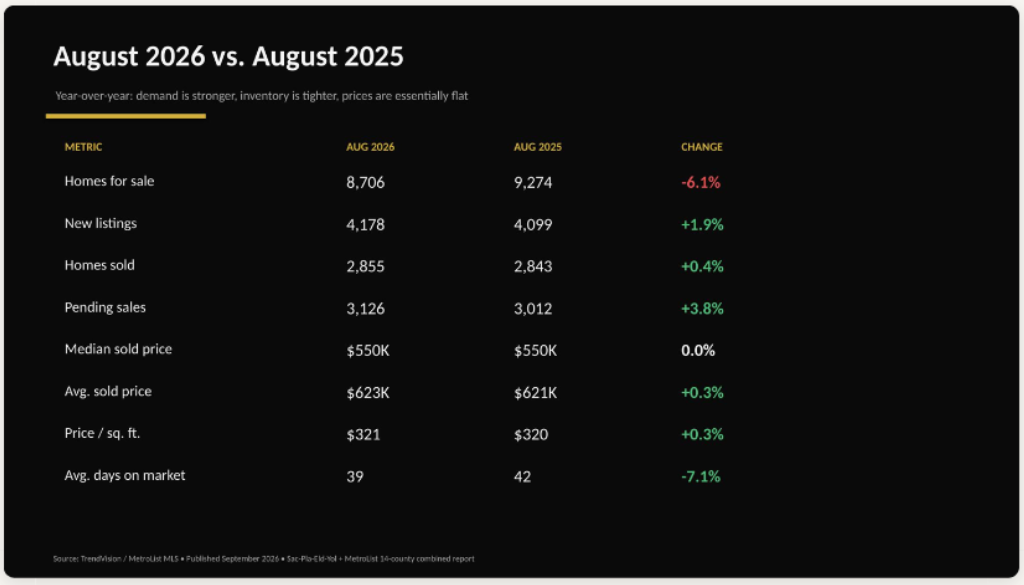
Active listings are still down 6.1% compared to August 2025, meaning there are fewer homes on the market today than there were a year ago. New listings are actually up 1.9%. Homes sold are up slightly (+0.4%). Pending sales are up a healthy 3.8%. Median sold price is dead flat at $550,000. Average sold price and price per square foot both nudged up about 0.3%. Average days on market decreased from 42 to 39 days. Put simply: demand is a touch stronger than it was a year ago, inventory is still tighter, and prices haven't moved. That's a market holding its ground, not one that's losing steam.
Pricing: Softer Than Last Month, Steady Compared to Last Year
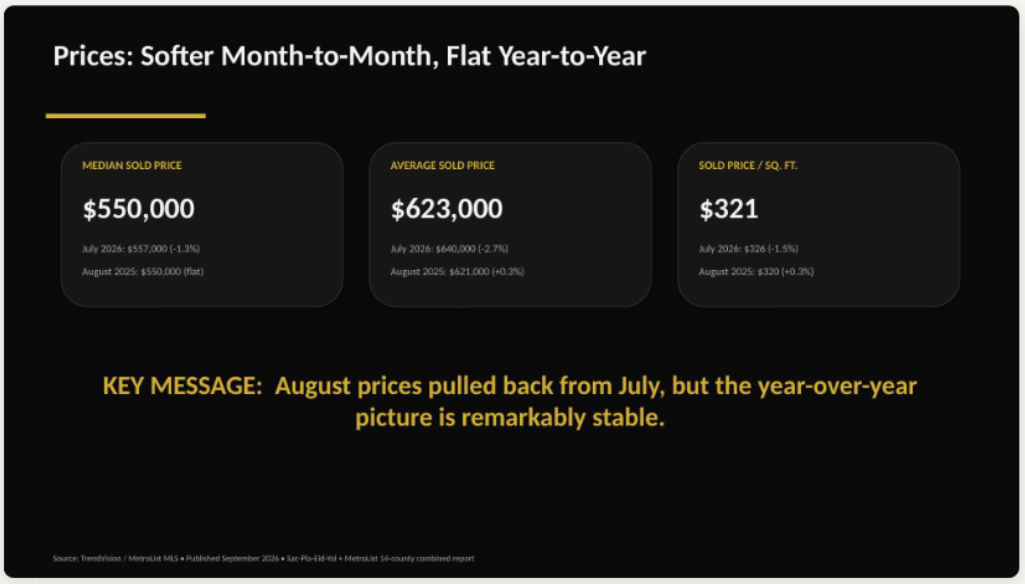
This is really the headline for August: prices pulled back a little from July's numbers, but the year-over-year picture is remarkably stable. Median sold price sits at $550,000, exactly where it was in August 2025. Average sold price is $623,000, up just 0.3% from a year ago. Price per square foot at $321 is essentially unchanged as well. If you're worried the market is starting to slide, the year-over-year number is the one to anchor on — and it says Sacramento pricing has held firm through a full year of higher rates and slower activity.
How Competitive Is It Really?
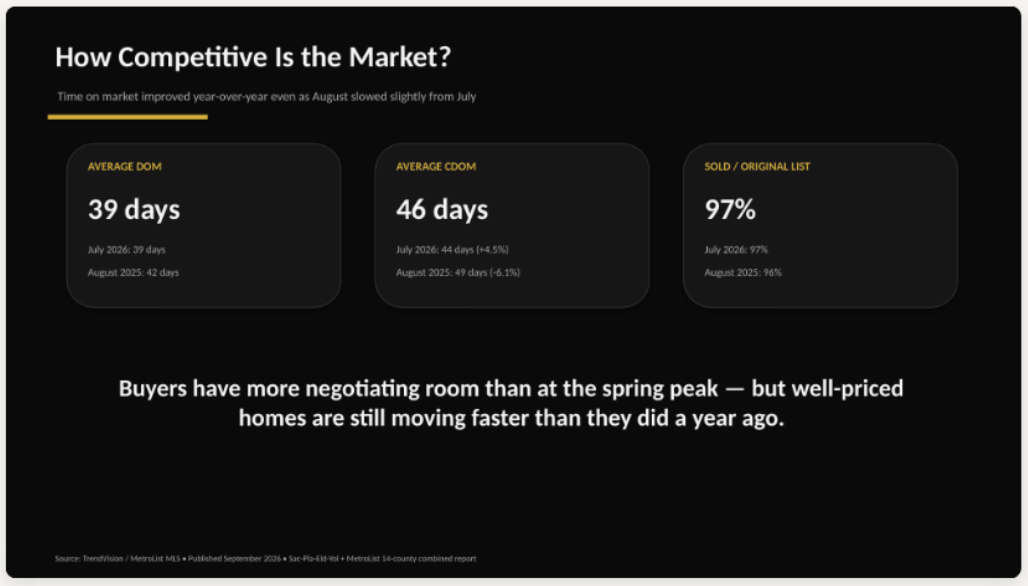
Average days on market came in at 39 days in August, matching July and down from 42 days a year ago. Cumulative days on market — which captures a listing's full time on market even if it was relisted — rose to 46 days, up from 44 in July but still better than the 49 days seen last August. Homes that did sell went for about 97% of their original list price, essentially matching July and slightly ahead of last year's 96%. The takeaway here is nuanced: well-priced homes are still moving faster than they did a year ago, and sellers who price correctly are still getting close to full asking price. But buyers clearly have more room to negotiate than they did during the spring peak, and homes that are priced even a little aggressively are sitting — sometimes for weeks — while comparable, realistically priced listings down the street go under contract.
A closer look at days on market
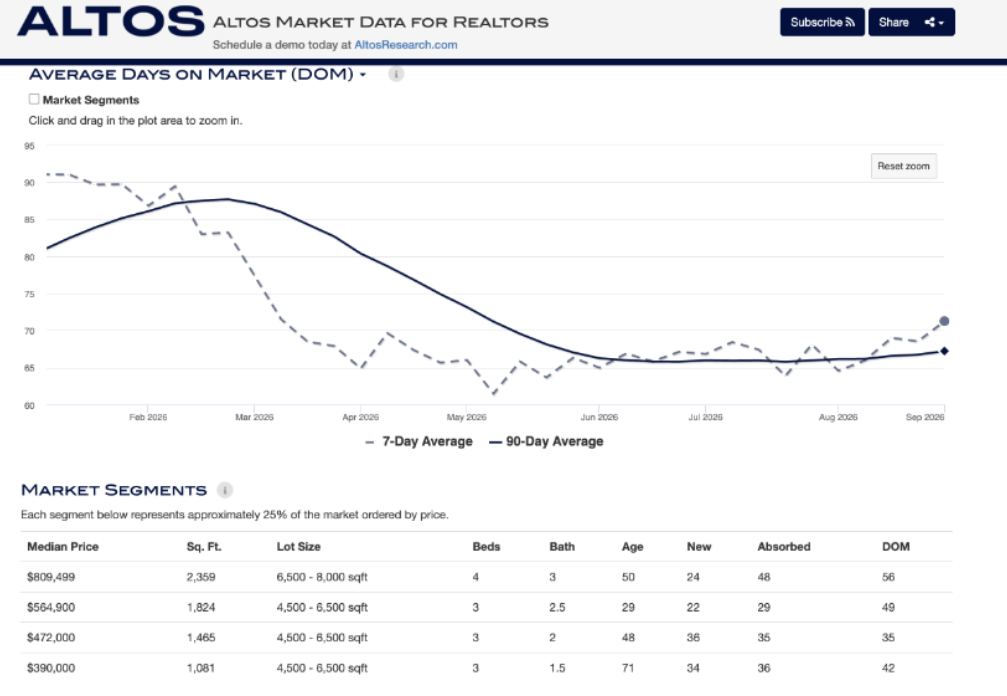
Independent tracking from Altos Research tells the same story from a different angle. Days on market spiked in the winter and early spring, as it typically does, then steadily improved through the summer months before ticking back up slightly heading into September — a normal seasonal pattern, not a warning sign.
And inventory
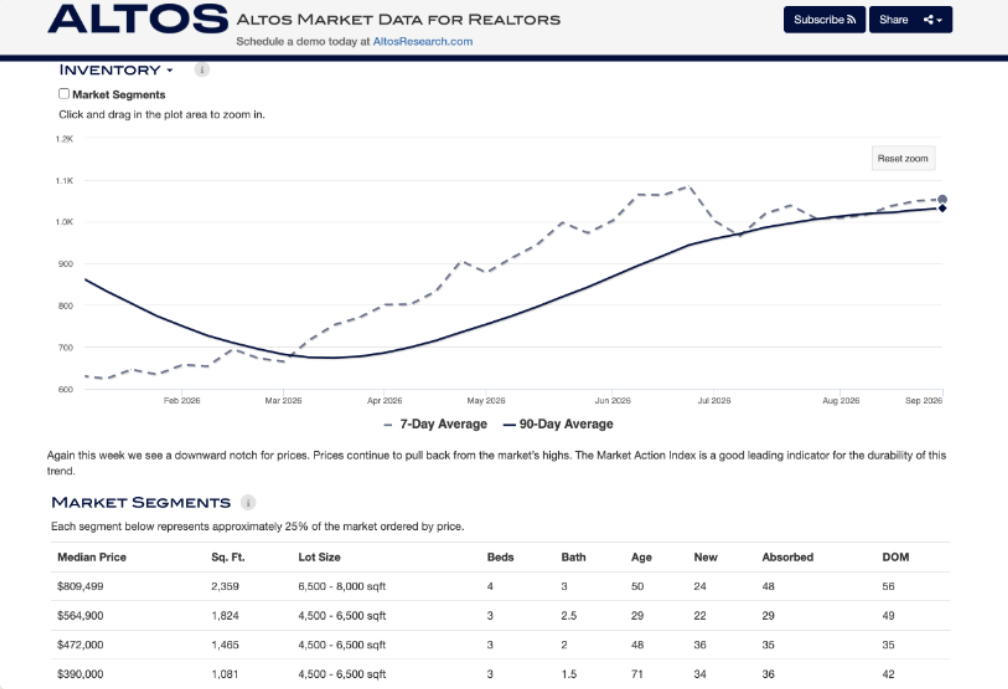
Inventory has been climbing steadily all year, more than doubling off its March low. More homes on the market gives buyers more to choose from and more leverage at the negotiating table — which brings us to the question everyone actually wants answered.
Is This a Buyer's Market or a Seller's Market?
Here's where it gets interesting. Pull up any market index for Sacramento right now and you'll see it labeled a "Strong Seller's Market."
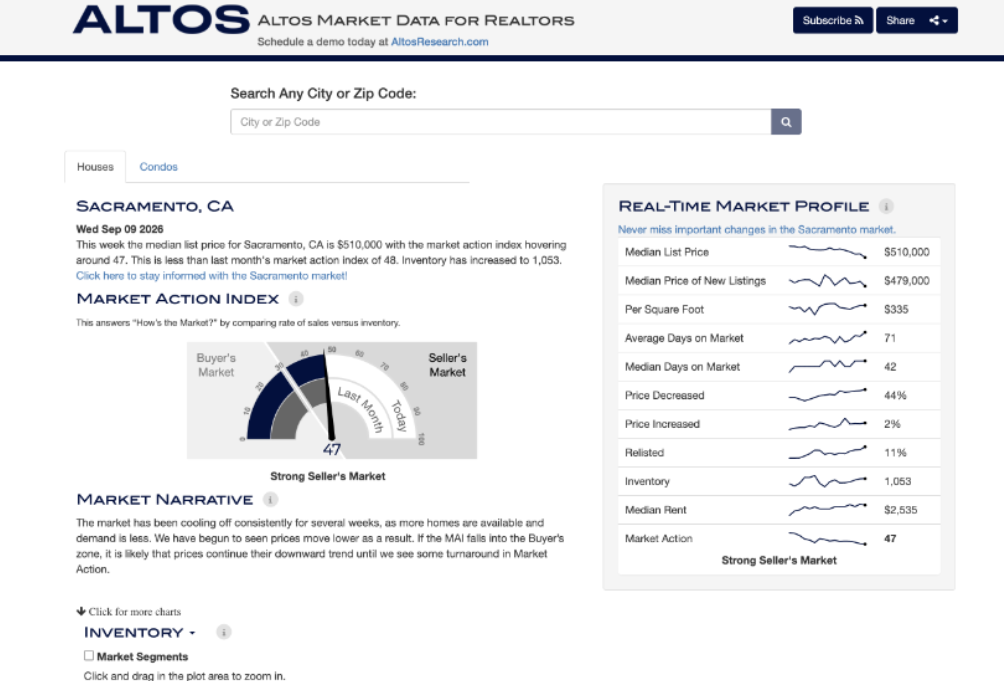
Technically, that's what the raw math says when you compare the pace of sales to available inventory. But talk to anyone actually writing offers and showing homes right now, and you'll hear a different story.
Buyers today simply aren't operating with the urgency they had two or three years ago. Nobody feels like they have to buy this week or miss out forever. Interest rates have crept higher rather than lower this year, headline economic news hasn't been especially encouraging, and a lot of buyers are choosing to wait, rent for a few months while they get to know an area, or simply take their time finding the right house instead of settling.
That shift in buyer psychology matters more than the index number. Homes that are priced right and located in perennially in-demand areas are still moving well. Homes that are priced even a little high are sitting — and sellers of those homes are increasingly willing to negotiate, offer credits, or come down in price rather than wait it out.
If you're house hunting right now, don't let a "seller's market" headline talk you out of negotiating. The data on the ground — softer closings, rising days on market for overpriced listings, and inventory that's climbed all year — backs buyers up more than the label suggests.
Where Mortgage Rates Stand
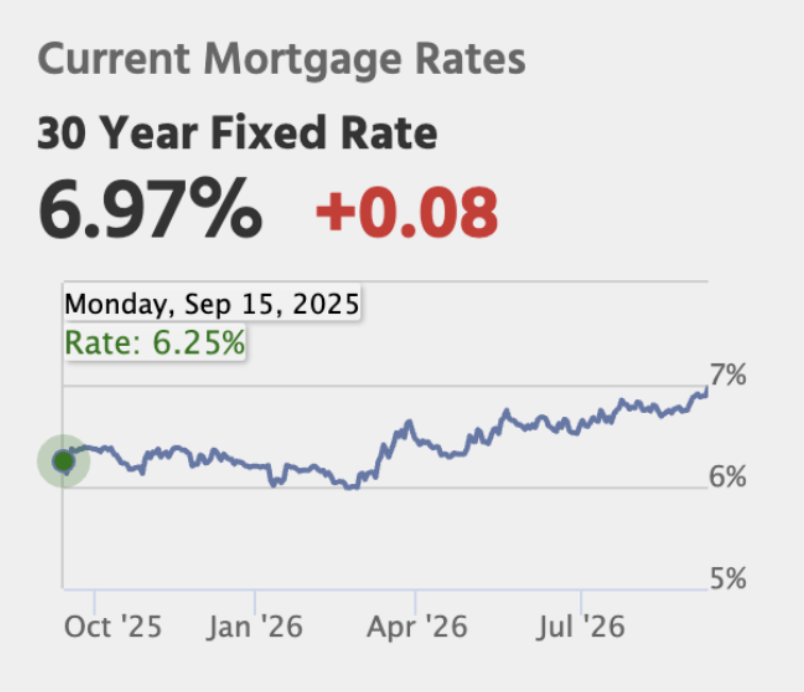
The 30-year fixed rate has been drifting upward through 2026 and is sitting close to 7% as of this report — noticeably higher than the roughly 6.25% we saw at this time last year. That difference matters less for the actual monthly payment than it does for buyer sentiment: a lot of people are anchored to what rates looked like a year or two ago and are hesitant to commit at today's numbers, even though historically a rate in the high-6s to 7% range isn't unusual.
Where rates land over the next several months — and how the market reacts to it — is likely to be one of the bigger stories heading into fall and winter.
New Construction Is Reshaping the Equation
One of the more notable shifts in our market this year is how competitive new construction has become with resale homes — and it's changing where a lot of buyers end up landing.
Builders across the region are offering meaningful incentives right now: rate buydowns that get buyers into the 4% to 5% range, help with closing costs, and increasingly generous quick-move-in deals as builders work to keep inventory moving. In some cases, a brand-new home with a builder-subsidized rate is pricing out competitively against an older resale home just down the street — and coming with a full builder warranty, updated systems, and none of the deferred maintenance that comes with an older house.
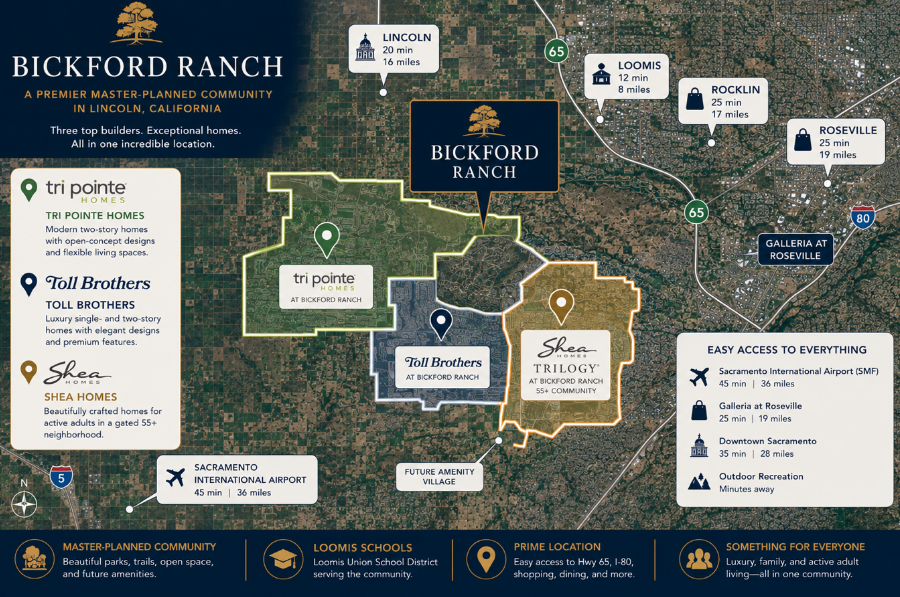
Builders active across the region right now include Toll Brothers (now building across Folsom, El Dorado Hills, Rocklin, and Rancho Cordova), Taylor Morrison and Tri Pointe/Woodside in Elk Grove, Lennar, KB Home, Beazer, and Meritage for more budget-friendly options, and Shea Homes moving into the Lincoln and Loomis area. Elk Grove in particular has seen new communities launch with starting prices in the high $400s to low $500s — a price point that's been hard to find in that market from any builder in recent memory.
If new construction is on your radar, it's worth understanding one trade-off before you fall in love with a floor plan: Mello-Roos. Most new communities in the Sacramento area carry a Mello-Roos tax bond — typically an extra $250 to $600 a month — that funds schools, parks, and infrastructure for the new community. It's not universal (a handful of newer communities have launched without it), but it's worth factoring into your monthly budget alongside HOA dues before you compare a new build to a resale home.
The Luxury Market Hasn't Slowed at All
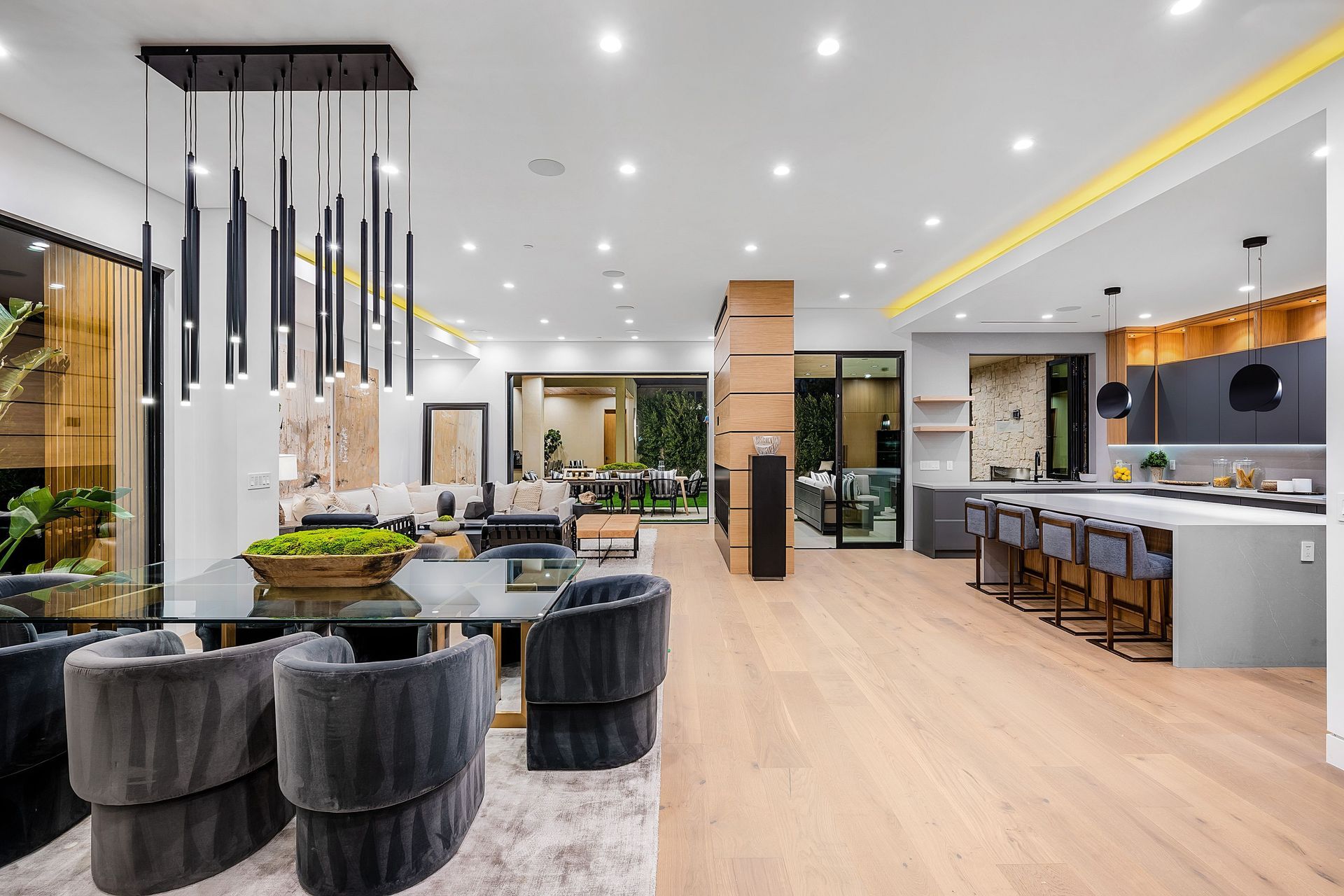
While the broader market has cooled seasonally, Sacramento's luxury segment continues to move at full speed. Buyers relocating from the Bay Area and other high-cost markets continue to view Sacramento pricing as a relative bargain, and builders have taken notice — several are actively expanding into larger custom and semi-custom lots in areas like Granite Bay, El Dorado Hills, and Loomis, with new communities starting well north of $2 million.
It's a sign of where this region is headed: more investment, more high-end construction, and continued confidence from builders that demand at the top of the market isn't going anywhere.
What This Means for Buyers and Sellers
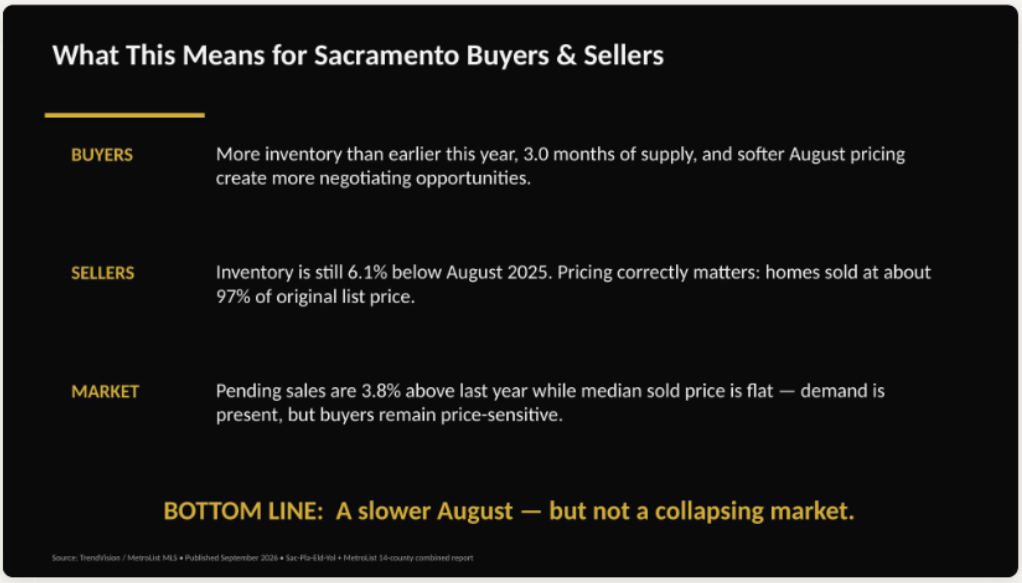
If you're buying, this is a market that rewards patience and preparation rather than urgency. Inventory is higher than it was earlier this year, months of supply sit at 3.0, and August pricing came in softer than July. That adds up to real negotiating room — especially on listings that have been sitting for a few weeks. Watch for the telltale signs of a motivated seller: staging that's been removed, a listing that's had a small price reduction or two, or a home that's been on the market for three weeks or longer. Those are the situations where a seller credit, a rate buydown, or a lower offer has a real shot. And if new construction fits what you're looking for, don't overlook it — today's builder incentives are some of the strongest we've seen, though they're worth weighing against Mello-Roos and HOA costs over the long run.
If you're selling, inventory is still 6.1% below where it was a year ago, and homes that are priced correctly are still selling in around 39 days at roughly 97% of list price — both better than last year's numbers. The catch is that buyers are price-sensitive right now, and they have options. Pricing realistically from day one matters more than ever; homes that launch too high tend to sit, need reductions later, and ultimately net less than if they'd been priced right from the start.
Bottom line: pending sales are running 3.8% above last year even as median price holds flat — real demand is still here, buyers just aren't going to overpay to satisfy it. This is a slower, more deliberate August. It is not a market in trouble.
Thinking about buying or selling in the Sacramento area, or relocating here from out of the region? I'd love to help you make sense of what's happening in your specific neighborhood. Reach out anytime — I'm always happy to talk through the numbers and what they mean for your situation.
Alona Sacramento Area Real Estate
Sources: TrendVision / MetroList MLS, published September 2026 (Sac-Pla-Eld-Yol + MetroList 14-county combined report); Altos Research market data for Sacramento, CA